Programmable digital quantum simulation of 2D Fermi-Hubbard dynamics using 72 superconducting qubits


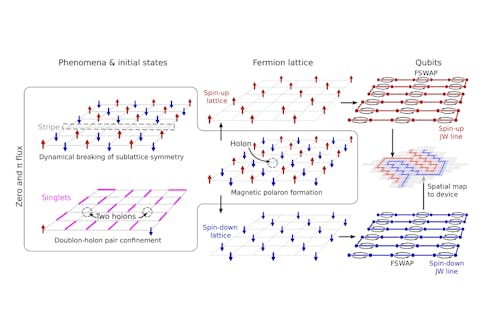
Simulating the time-dynamics of quantum many-body systems was the original use of quantum computers proposed by Feynman, motivated by the critical role of quantum interactions between electrons in the properties of materials and molecules. Accurately simulating such systems remains one of the most promising applications of general-purpose digital quantum computers, in which all the parameters of the model can be programmed and any desired physical quantity output. However, performing such simulations on today's quantum computers at a scale beyond the reach of classical methods requires advances in the efficiency of simulation algorithms and error mitigation techniques. Here we demonstrate programmable digital quantum simulation of the dynamics of the 2D Fermi-Hubbard model - one of the best-known simplified models of electrons in crystalline solids - at a scale beyond exact classical simulation. We implement simulations of this model on lattice sizes up to 6×6 using 72 qubits on Google's Willow quantum processor, across a range of physical parameters, including on-site electron-electron interaction strength and magnetic flux, and study phenomena including formation of magnetic polarons, i.e. charge carriers surrounded by local magnetic polarisation, dynamical symmetry breaking in stripe-ordered states, attraction of charge carriers on an entangled state known as a valence bond solid, and the approach to equilibrium through thermalisation. We validate our results against exact calculations in parameter regimes where these are feasible, and compare them to approximate classical simulations performed using tensor network and operator propagation methods. Our results demonstrate that programmable digital quantum simulation of many-body interacting electron models is now competitive on state-of-the-art quantum hardware.


